 CareCompass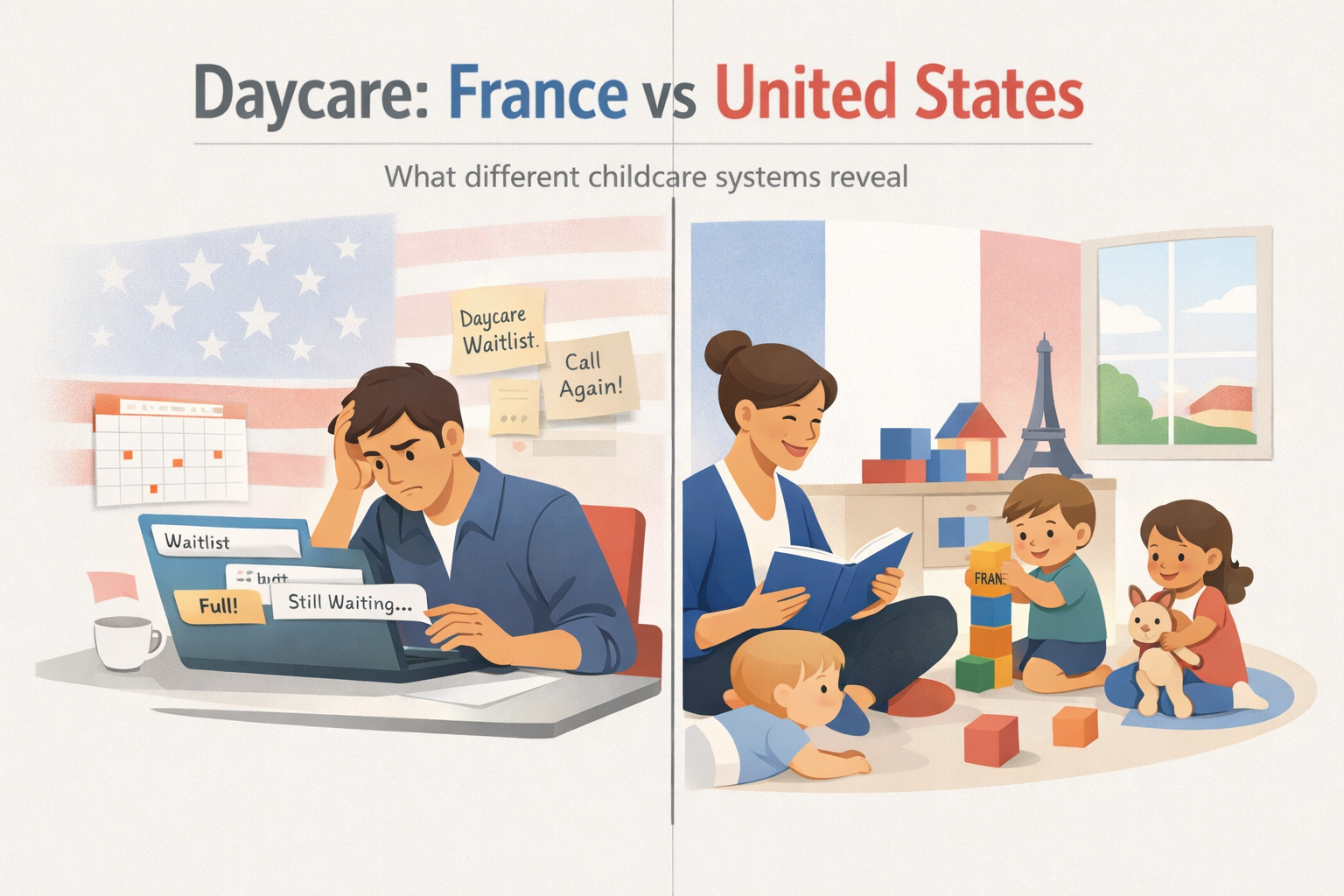
What French Parenting Gets Right About Daycare — And What It Reveals About the U.S.
French and American parents often view daycare very differently. In France, early childcare is treated as a normal part of childhood and supported as public infrastructure. In the United States, families often face high costs, limited availability, and difficult tradeoffs. Here’s what these differences reveal about childcare systems — and what they mean for parents today.
In American parenting culture, daycare is often framed as a reluctant necessity — something families use because they have to.
In France, it’s frequently viewed differently: as a normal, respected, and developmentally appropriate part of early childhood.
This contrast has been widely discussed in books like Bringing Up Bébé by Pamela Druckerman (2012), which compares American and French parenting norms. But the differences go beyond parenting style — they reflect deeper structural, cultural, and policy distinctions between the two countries.
Understanding those differences can reshape how we think about childcare in the U.S.
Daycare as Infrastructure vs. Daycare as Individual Choice
One of the biggest differences between France and the United States is how childcare is positioned socially.
In France, early childcare is generally treated as public infrastructure — similar to education. The French system includes state-supported crèches (public childcare centers), regulated family-based care, and école maternelle (public preschool beginning at age three), which is nearly universal and publicly funded (OECD, 2023).
In the United States, childcare is largely privatized and market-based. Families navigate a patchwork of:
• Private centers
• Home daycares
• Employer benefits (if available)
• Subsidy programs (if eligible)
Because of this structure, daycare in the U.S. is often framed as a personal decision tied to employment — rather than a societal norm.
Cultural Attitudes Toward Early Independence
French parenting philosophy often emphasizes gradual independence from an early age. As Druckerman describes, French parents tend to view structured early childcare as beneficial for socialization and autonomy (Druckerman, 2012).
In the U.S., conversations around daycare sometimes center on:
• Concerns about bonding
• Guilt around time away from children
• Debates over “stay-at-home vs working parent”
The difference isn’t necessarily about love or involvement. It’s about how society collectively frames early childhood care.
When childcare is normalized and widely available, it carries less moral weight.
The Cost Question
Affordability is another major divergence.
France heavily subsidizes early childcare through public funding and family benefits. According to OECD data, France spends significantly more public funds on early childhood education and care as a share of GDP than the United States (OECD Family Database, 2023).
In contrast, American families often bear a large share of childcare costs directly. In many U.S. cities, full-time daycare can rival housing expenses.
This economic reality shapes perception:
• In France, daycare is part of the system.
• In the U.S., daycare can feel like a financial strain layered onto working parenthood.
Availability and the Care Gap
Neither system is perfect.
France has faced its own childcare shortages in certain regions. However, the U.S. is currently experiencing a well-documented childcare supply-demand imbalance often referred to as the “childcare gap” or “childcare desert” issue (Center for American Progress, 2022).
In many American communities:
• There are not enough licensed childcare slots for the number of children who need them.
• Families join waitlists months before birth.
• Geographic inequities limit access.
When access is uncertain, stress increases.
What This Means for Parents in the U.S.
It would be unrealistic to suggest that American families can simply adopt French norms. Structural conditions matter.
But there are lessons worth reflecting on:
1. Daycare Is Not a Failure
In cultures where childcare is normalized, parents are less likely to view it as a compromise.
2. Socialization Has Value
Structured early environments can provide peer interaction and routine — benefits recognized internationally.
3. The System Shapes the Stress
Much of the anxiety surrounding daycare in the U.S. stems not from childcare itself, but from:
• High costs
• Limited transparency
• Scarcity of spots
• Unclear comparisons
When access feels uncertain, every decision feels heavier.
Reframing the Conversation
The difference between French and American views on daycare isn’t about who loves their children more.
It’s about:
• Public investment
• Cultural expectations
• Structural access
• Information transparency
Until broader policy changes occur, American families still have to navigate the system as it exists.
But understanding that some of the stress is structural — not personal — can be relieving.
Childcare decisions are deeply emotional. They’re also shaped by policy and infrastructure.
Recognizing that distinction helps parents move from guilt to clarity.
Final Thoughts
The French model reminds us that childcare can be viewed as:
• Developmental
• Normal
• Social
• Supported
In the United States, many families are still navigating scarcity and fragmentation.
Greater transparency, clearer comparisons, and more accessible information won’t solve supply shortages overnight — but they can reduce decision fatigue.
And sometimes, clarity is the first step toward confidence.
Sources
• Druckerman, P. (2012). Bringing Up Bébé: One American Mother Discovers the Wisdom of French Parenting. Penguin Press.
• OECD Family Database (2023). Public spending on early childhood education and care.
• Center for American Progress (2022). America’s Child Care Deserts.
Find the perfect daycare near you
Browse top-rated daycares, preschools, and Montessori schools.
Search Daycares